
1888
1946
Pennsylvania, USA
American
Pippin painted about 140 works, many of which are in museum collections These include the Metropolitan Museum of Art, New York, Hirshhorn Museum and Sculpture Garden, Washington DC,
Pennsylvania Academy of the Fine Arts, Philadelphia, Philadelphia Museum of Art,
Philadelphia, The Barnes Foundation, Philadelphia, the Brandywine River Museum, Chadds Ford, Pennsylvania, the Phillips Collection, Washington DC,; Baltimore Museum of Art, Baltimore, and San Francisco Museum of Modern Art, San Francisco.
Pippin was the first African American artist to be the subject of a monograph, Selden
Rodman’s Horace Pippin: A Negro Painter in America of 1947. He has since been the subject of three major retrospective exhibitions, several scholarly books and articles, a book of poetry, and several children’s books.
Horace Pippin. Phillips Collection, Washington DC 25 February –March 1977, Terry Dintenfass Gallery, New York, April April 1977and Brandywine River Museum of Art, Chadds Ford,4 June 4–5 September 1977
I Tell My Heart: The Art of Horace Pippin. Pennsylvania Academy of the Fine Arts, Philadelphia, 21 January– 17 April 1994, Art Institute of Chicago, 30 April – 10 July 1994; Cincinnati Art Museum, 28 July – 9 October 1994, Baltimore Museum of Art, October 1994 – January 19951994 – January 1, 1995; and the Metropolitan Museum of Art, February 1–April 30, 1995.
Horace Pippin: The Way I See It. Brandywine River Museum of Art, Chadds Ford 25 April – 19 July 2015
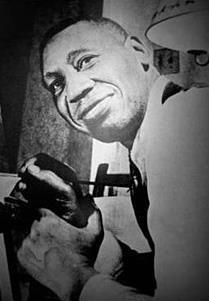
Pippin was born in West Chester, Pennsylvania on 22 February1888 to Harriet Pippin although his father’s identity is unknown. He grew up in and around Goshen, New York, where he attended segregated schools until he was 15 years old, when he went to work to support his ailing mother. As a boy, Horace responded to an art supply company’s advertising contest and won his first set of crayons and a box of watercolours. He also made drawings of racehorses and jockeys from Goshen’s celebrated racetrack. Prior to his service in World War I, Pippin worked as a hotel porter, a furniture packer, and an iron moulder. He was a member of St. John’s African Union Methodist Protestant Church. In 1920, Pippin married Jennie Fetherstone Wade Giles, who had been widowed twice and had a son aged six years.
In World War 1 Pippin served in K Company,,the 3rd Battalion of the 369th infantry regiment, known as the Harlem Hellfighters for their bravery in battle. The predominately Black unit faced racism, especially before they were transferred to the command of the French Army. They were the longest serving US regiment on the war’s frontlines, holding their ground against enemy fire almost continuously from mid July until the end of the war. The regiment as a whole was awarded the French Croix de Guerre. In September 1918, Pippin was shot in the right shoulder by a German sniper, an injury which initially cost him the use of his arm and which always limited his range of motion. He was honourably discharged in 1919 and in 1945 he was retroactively awarded a Purple Heart for his combat injury. He said of his combat experience
“I did not care what or where I went. I asked God to help me, and he did so. And that is the way I came through that terrible and hellish place. For the whole entire battlefield was hell, so it was no place for any human being to be.”
After the war, Pippin wrote four memoirs, one of which wasillustrated, that describe his harrowing military service in detail. He returned to war subjects periodically throughout the 1930s and 1940s, and later said that WWI “brought out all the art in me”.
Pippin took up art in the 1920s, reportedly in part to rehabilitate his injured arm, and began painting on stretched fabric in 1930 with The Ending of the War: Starting Home. He later explained his creative process “The pictures which I have already painted come to me in my mind, and if to me it is a worthwhile picture, I paint it.” He addressed a range of themes, from landscapes and still life to biblical subjects and political statements. Some draw on his personal experience of the war or turn-of-the-century domestic life.
He was discovered when he submitted two paintings to the Chester County Art Association (CCAA) Annual Exhibition, with the aid and encouragement of various locals, including CCAA cofounders art critic Christian Brinton and artist N C Wyeth.[5]Brinton immediately organized a solo exhibition, cosponsored by the CCAA and the interracial West Chester Community Centre, and connected him with MoMA curators Dorothy Miller and Holger Cahill and, by 1940, the Philadelphia art dealer Robert Carlen and collector Albert C Barnes.
Pippin attended art appreciation classes at the Barnes Foundation in the spring 1940 semester. Carlen, Barnes, and dealer Edith Gregor Halpert played prominent roles in Pippin’s career.
In the eight years between his national debut in the Museum of Modern Art’s travelling exhibition
Masters of Popular Painting (1938) and his death at the age of fifty eight years, Pippin’s recognition grew across the country and internationally. During this period, he had solo exhibitions in commercial galleries in Philadelphia (1940, 1941) and New York (1940, 1944), and at the Arts Club of Chicago (1941) and San Francisco Museum of Modern Art (1942). Private collections and museums such as the Barnes Foundation, the Philadelphia Museum of Art and the Whitney Museum of American Art acquired his works. His paintings were featured in annual
or biennials at the Art Institute of Chicago, Chicago, Carnegie Institute, Pittsburgh, Corcoran Gallery of Art, Washington DC, Pennsylvania Academy of the Fine Arts, Philadelphia, and the Whitney Museum of American Art, New York, as well as thematic surveys at the Dayton Art Institute, National Gallery of Art, Washington DC; Newark Museum, Newark, New Jersey and Tate Gallery, London, [5]
In a 1947 memorial exhibition, critic Alain Locke described Pippin as “a real and rare genius, combining folk quality with artistic maturity so uniquely as almost to defy classification.”
https://www.metmuseum.org/art/collection/search/482605
https://www.britannica.com/biography/Horace-Pippin
https://www.nga.gov/collection/artist-info.25.html
https://en.wikipedia.org/wiki/Horace_Pippin
https://www.wikiart.org/en/horace-pippin
https://www.moma.org/artists/4635